
Why are our sex drives so different?
This article explores the tension of conflicting sexual motivations, the reasons you pursue sex in the first place, rather than the frequency of sexual desire.
When Desire Isn’t the Problem
Couples often approach sexual desire through the lens of “high desire” versus “low desire” (i.e. frequency) When partners experience different levels of desire, this is often described as mismatched desire.
While differences in desire frequency certainly exist, sometimes what appears on the surface to be mismatched desire is actually something deeper: conflicting or competing sexual motivations.
In other words, partners may not simply differ in how often they want sex. They may differ in why they want sex in the first place. This can be an explanation for why sex drives feel so different.
Understanding these motivations can significantly shift how couples interpret sexual tension, dissatisfaction, and avoidance.
(You can read more about mismatched desire here)
Why do Partners Want Sex for Different Reasons?
The reasons people seek sex are shaped by many factors:
Psychological: this includes personality traits, personal beliefs and attitudes about sex, mental and emotional health factors.
Relational: past relationship history may shape our expectations around sex. This can also include family upbringing and peer group contexts that shape our ideas about what sex is and means.
Biological: the biological urge for sex, hormones, how our body is wired, the physical health of our body.
Societal and Cultural: traditions or messages in broader society that shape our views on sex.
We are all unique individuals that are influenced by our mind, bodies, relationships (family, friends, partners, role-models), and the wider community and culture we live in. For example, someone raised in the 1960s during the sexual revolution may have very different sexual motivations in contrast to an individual raised in a Catholic household at that same time.
The Many Reasons People Seek Sex
Research into sexual motivation has identified over 230 distinct reasons why people engage in sexual activity.
These reasons can broadly be grouped into several themes:
Physical and Sensory Pleasure- This drive is all about the bodily experience and the sheer fun of the act itself. It covers the fundamental biological urge for release, the craving for skin-to-skin contact, and the pursuit of thrilling, novel, or highly stimulating physical sensations.
Emotional Connection and Intimacy- People motivated by this are looking to communicate love and build a secure, trusting bond with their partner. It is about sharing vulnerability, bridging any emotional or physical gaps that have formed between them, and relying on physical closeness to ward off feelings of isolation while demonstrating deep affection.
Stress Relief, Coping, or Escape - In this context, physical intimacy serves as a coping mechanism. Individuals might use the natural chemical rush and physical exhaustion of climax to self-medicate against anxiety, unwind after a highly demanding day, or mentally check out from their everyday responsibilities and difficult emotions.
Self-Esteem, Validation, and Identity- This category revolves around using sexual encounters to feel better about oneself. It includes wanting to feel irresistible or highly desired by someone else, bolstering personal confidence, and using the sexual act to confirm one's sense of gender identity, youth, vitality, or personal empowerment.
Goal Attainment, Utility, and Insecurity- Here, the sexual act is a tool used to achieve a separate objective or to manage relationship fears. It ranges from engaging in intimacy out of a feeling of obligation or to keep a partner from looking elsewhere (mate-guarding), to more transactional motives like gaining a social advantage, exchanging favors, or even acting out of spite.
Spiritual, Celebratory, or Transformational Experiences- This encompasses viewing physical intimacy as a sacred, deeply expansive, or mindful practice. It might involve seeking a higher state of consciousness, joyfully honoring major life milestones (like an anniversary), or using the profound nature of the connection to foster healing and reaffirm life following a period of grief or hardship.
Biological Purpose and Family Building- This motivation is rooted in our biological design to reproduce. It involves engaging in intercourse specifically to achieve a pregnancy, pass down genetic traits, and fulfill the deeply ingrained human aspiration to create a lineage and nurture a growing family.
Each person has their own unique set of motivations for seeking sex. Some motivations reflect core human needs, such as connection and bonding. Others reflect preferences or desires, such as pleasure or novelty.
The important point is that people rarely approach sex with the exact same motivations.
When Sexual Motivations Clash
Where couples can struggle is when partners approach sex with different underlying motivations.
For example:
One partner may seek sex primarily for emotional connection and intimacy
The other partner may seek sex for self-esteem, validation, or reassurance
Neither motivation is inherently wrong. However, when these motivations are unspoken or misunderstood, partners can experience a sense of misalignment during sexual activity.
This misalignment can lead to:
feelings of disconnection during sex
disappointment or dissatisfaction
confusion about a partner’s level of desire
Over time, this may appear to look like mismatched libido, when the deeper issue is actually mismatched motivations.
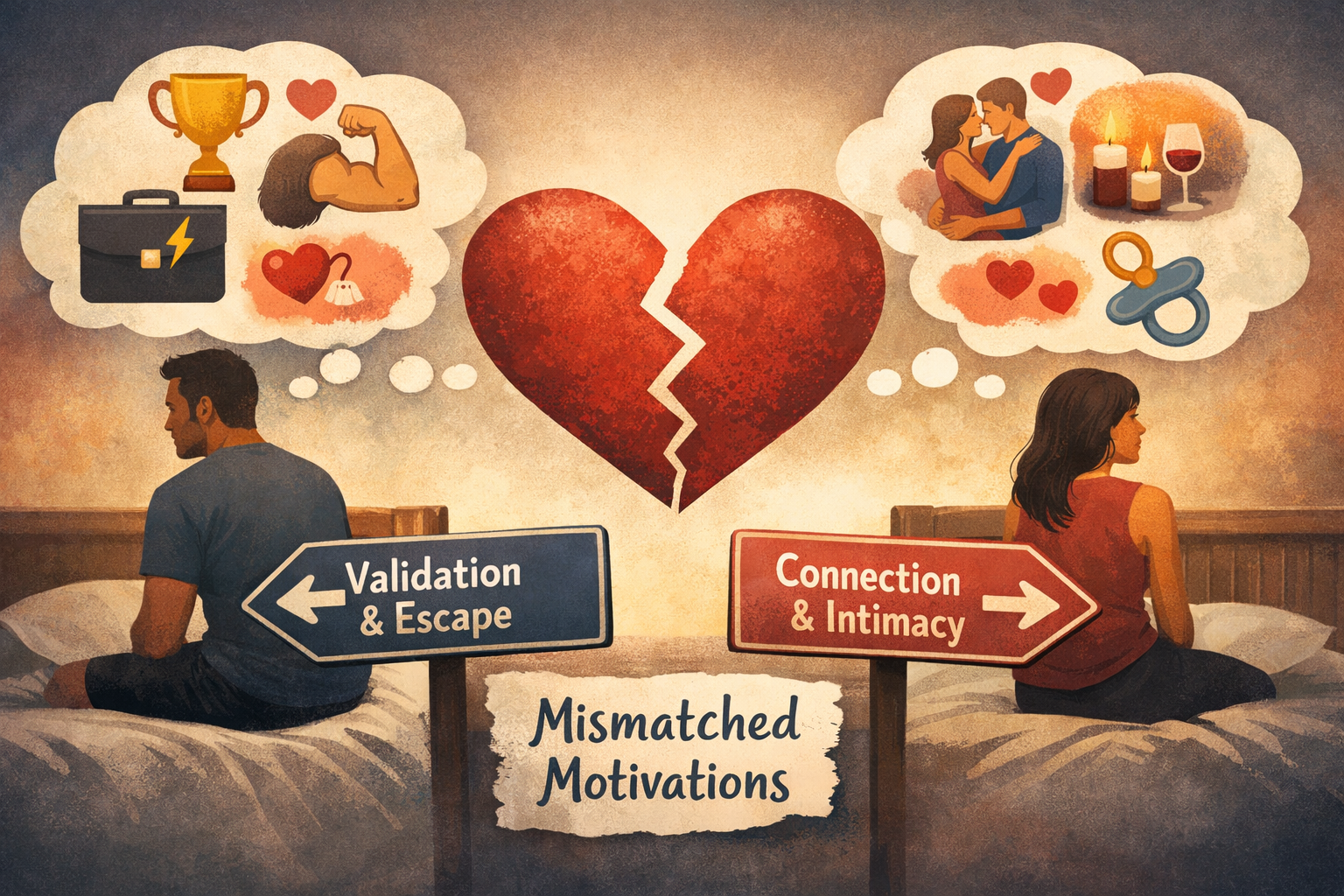
When motivations are not recognised and understood, this can create a clash when it comes to sexual intimacy.
How Pressure and Avoidance Develop
When motivations are not understood, couples can easily fall into a pressure and avoidance cycle.
One partner may seek sex more intensely because they hope it will meet an important emotional need such as:
feeling desired
feeling valued
feeling connected
feeling reassured in the relationship
At the same time, the other partner may feel the growing pressure around sex and begin to withdraw.
This creates a common cycle:
One partner increases pressure for sex
The other partner pulls away
The increased avoidance amplifies the pressure
The cycle becomes harder to reverse
Eventually, both partners become dissatisfied. The partner seeking sex feels rejected or starved of connection. The partner avoiding sex feels pressured or overwhelmed. Nobody enjoys this dynamic.
When Sex Becomes the Only Way to Meet a Need
Another important factor to consider is how many needs are being placed onto sex itself.
Sometimes one partner may unconsciously place many emotional needs into the single basket of sexual activity, such as:
feeling loved
feeling valued
feeling confident
relieving stress
feeling connected
feeling reassured about the relationship
When sex becomes the primary pathway for meeting many different needs, the pressure on sexual activity can become enormous. This often happens in dynamics where one partner feels that sex is the only place those needs can be met.However, many of these needs, while valie, are not exclusively sexual needs. They are needs that can also be fulfilled in other relational ways.
Moving From Starvation to Generosity
When a person approaches sex from a place of emotional starvation, it often increases pressure and urgency around sexual encounters. Coming to sex in this way can create unrealistic expectations for what sex can provide. Sex cannot sustainably fulfil every emotional hunger in the long term. It cannot act as a saviour for all unmet needs. It can also place an unfair burden on the partner, who is unlikely to be able to consistently meet all of those needs through sexual activity alone.
When couples learn to meet some of their emotional needs in other ways, something important happens:
Sex becomes less pressured.
Rather than approaching sex from a place of hunger or desperation, partners can approach it from a place of generosity, curiosity, and enjoyment. Taking pressure off sex often allows couples to enjoy sex more.
Becoming a Sexual Team
One of the most helpful shifts couples can make is to become a sexual team. This begins with understanding each other’s motivations for sex.
Questions couples might explore include:
What are my reasons for wanting sex?
What emotional needs, wants or desires, am I hoping sex will meet?
What are my partner’s motivations for sex?
Where do our motivations overlap, even in small ways?
You may not always agree. Your motivations may never fully align. However, even small areas of shared motivation can become places where intimacy grows.
When couples strengthen those shared motivations, sexual experiences can become more collaborative, relaxed, and satisfying.
How Sex Therapy Can Help
Many couples find it difficult to identify and communicate their motivations for sex on their own.
Couples counselling or sex therapy can help partners:
understand the emotional meaning sex holds for each person
break cycles of pressure and avoidance
expand the ways emotional needs are met within the relationship
develop a shared language around intimacy and desire
strengthen emotional and sexual connection
When partners begin to understand not just how often sex happens, but why it matters to each person, intimacy often becomes easier to navigate.
I offer online sex therapy for couples across Australia, supporting partners navigating desire differences and sexual intimacy concerns.
Final Reflection
Differences in sexual desire are common in long-term relationships. However, what appears to be mismatched libido may sometimes be a difference in sexual motivations rather than desire itself. When couples begin to understand the deeper reasons behind their sexual needs, the pressure surrounding sex often softens. Sex becomes less about meeting every emotional need and more about shared connection, curiosity, and enjoyment…And from that place, intimacy often becomes easier to rediscover.
Written by Justine
References
Meston CM, Buss DM. Why humans have sex. Archives of Sexual Behavior. 2007;36(4):477-507.
Nagoski E. Come as you are: The surprising new science that will transform your sex life. New York: Simon & Schuster; 2015
McCarthy B, McCarthy E. Discovering your couple sexual style. New York: Routledge; 2009.
Hill CA, Preston LK. Individual differences in the experience of sexual motivation: Theory and measurement of dispositional sexual motives. Journal of Sex Research. 1996;33(1):27-45.
